Dress code guide
Business casual
Also written Business casual attire, Business casual dress code, Office casual, Corporate casual
Tailored but tieless, and comfortable enough for a full day at your desk.
What it means
Business casual means office-ready clothes that stop short of a suit: collared shirts, blouses and sweaters with chinos, dress pants or knee-to-midi skirts, and polished shoes. Ties are optional, and jeans depend on your workplace.
Styled on fictional Avarobe avatars.
What business casual really means
Business casual is the everyday dress code at a huge range of American workplaces, and it's also the vaguest. It sits between a suit and weekend clothes: you keep the tailoring, drop the tie, and choose pieces that look put together from the morning commute to the last meeting. Picture a crisp shirt or silk blouse, pressed chinos or wool trousers, a knit or blazer for structure, and leather shoes you can walk in all day.
The rules have loosened since offices reopened. Many companies now accept dark jeans, knit polos and clean leather sneakers, while law firms, banks, government offices and client-facing teams still expect something closer to trousers and a blazer. Below you'll find business casual outfit formulas for men and for women, the fabrics and shoes that work, and straight answers on the gray areas. The menswear and womenswear sections describe clothes, not who has to wear them, so borrow freely.
When you'll see it
- An offer letter or employee handbook describing the office dress code
- Job interviews at companies where the team dresses down day to day
- Client lunches, networking events and industry mixers
- Conferences, trade shows and training days
- Team offsites and work dinners that start straight from the office
- Your first week at a new job, before you've learned the unwritten rules
Business casual for women
Business casual for women is built on separates: a blouse, shell or fine knit with tailored pants or a knee-to-midi skirt, plus a blazer or cardigan when you want more structure. Dresses count too, as long as the fabric has some weight and the neckline and hem suit a meeting. Aim for pieces that still look neat after hours of sitting.
Lengths: Keep skirts and dresses at the knee or below, or an inch or two above at most. Sit down in front of a mirror: if the hem climbs toward mid-thigh, save it for the weekend. Midi lengths are the safest choice. Pants can be full-length or ankle-length if they're tailored. Petite frames look sharpest in knee-grazing hems and pants that end at the ankle bone; tall frames should check that trouser hems reach the top of the shoe.
Outfits that work
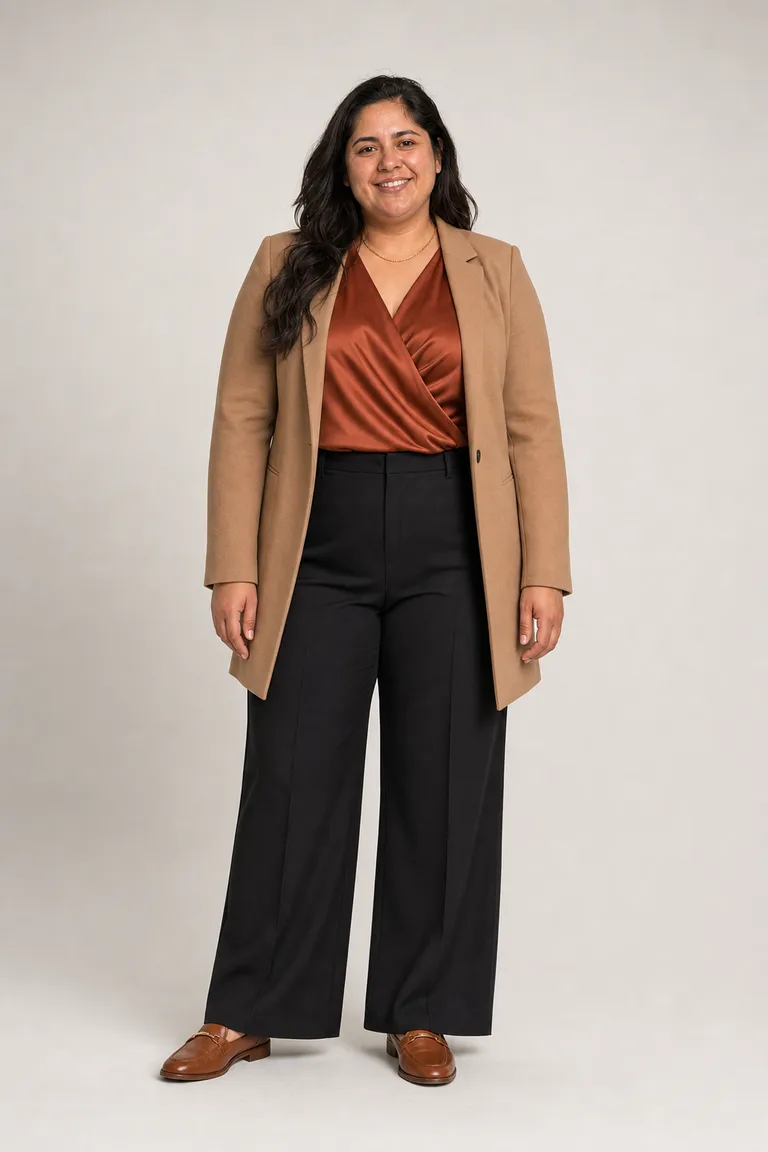
- Rust satin wrap blouse, black wide-leg trousers, a camel longline blazer and cognac loafers. On a plus-size frame, the wrap shapes the waist and the long blazer draws one unbroken line.
- Fine-gauge merino sweater tucked into a pleated midi skirt, with a slim belt and knee boots or loafers.
- Knee-length ponte sheath dress with a cropped cardigan or collarless jacket and block-heel pumps.
- Petite option: a silk shell and ankle-length straight trousers in the same color, a cropped blazer and pointed flats. One color head to toe and a pointed toe add visual height.
- Cotton poplin shirt dress with a leather belt and loafers, or clean white leather sneakers where the office allows them.
- Dark, clean straight-leg jeans (only where denim is allowed) with a tucked blouse, a structured blazer and leather ankle boots.
- Fabrics
- Wool crepe and tropical wool for trousers and blazers
- Ponte and heavy matte jersey for dresses and pull-on pants
- Silk, crepe de chine and matte satin for blouses
- Merino and cashmere for sweaters and cardigans
- Cotton poplin and twill for shirts, shirt dresses and chinos
- Shoes
- Leather or suede loafers
- Pointed or almond-toe flats
- Block-heel pumps, 1.5 to 2.5 inches
- Low-heel leather ankle boots
- Minimal leather sneakers, in relaxed offices only
- Accessories
- A structured leather tote that fits a laptop
- Studs, small hoops or a single pendant
- A slim belt for dresses and tucked tops
- A simple watch
- A cardigan or silk scarf for overcooled offices
Business casual for men
Business casual for men starts with a collared shirt and trousers that aren't jeans, finished with leather shoes and a belt that matches them. A tie is optional, and a blazer or sport coat covers you for meetings. In many offices, a good knit polo or a sweater over a collar also qualifies.
Outfits that work
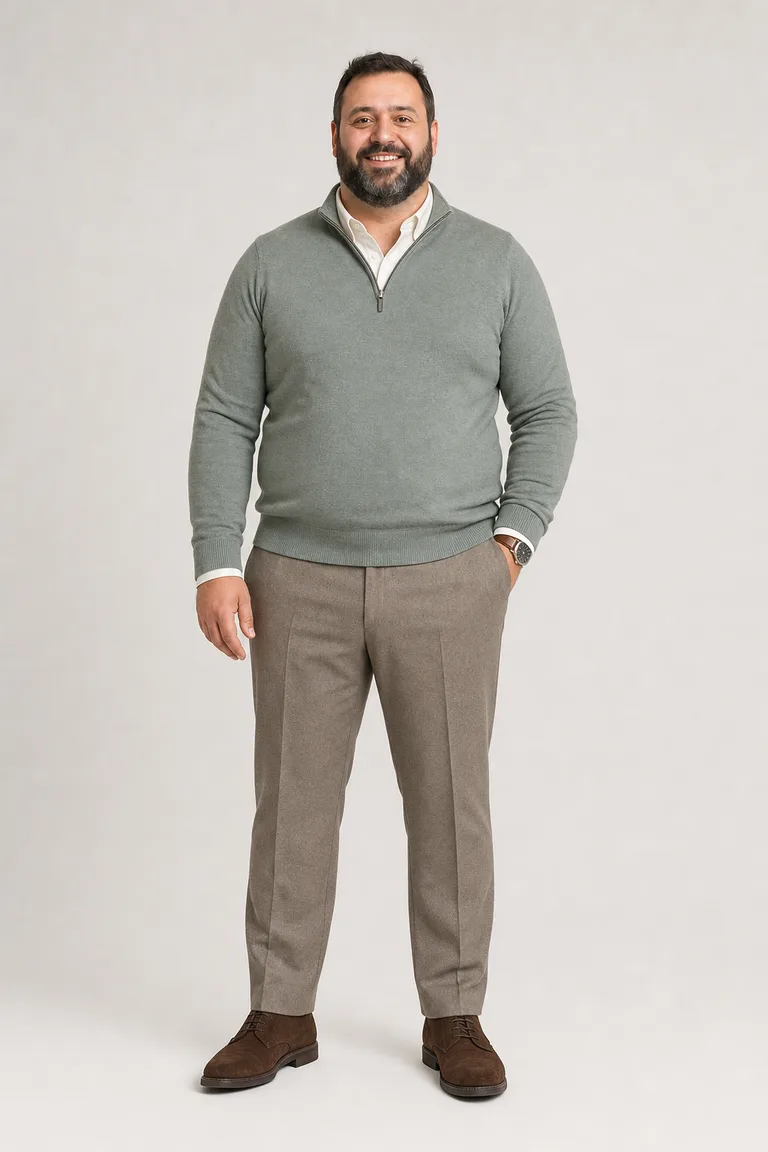
- Sage merino quarter-zip over an ivory oxford shirt, taupe wool trousers and chocolate suede derbies.
- White or light blue dress shirt with no tie, charcoal wool trousers, and a dark brown belt with matching leather derbies.
- Solid knit polo tucked into khaki chinos, with a brown leather belt and loafers, for warm months or relaxed offices.
- Navy sport coat over a blue gingham or fine-striped shirt, with gray trousers and brown brogues, for client-facing days.
- Dark, unripped jeans (only where denim is allowed), a crisp button-down, a textured blazer and leather Chelsea boots.
- Big & tall option: a darker shirt under an open single-breasted sport coat, flat-front trousers with a slight break, and cap-toe derbies. Small patterns and colors close in depth keep the line long.
- Fabrics
- Oxford cloth, poplin and twill for shirts
- Cotton twill and wool for chinos and trousers
- Merino and cotton knits for sweaters and polos
- Wool hopsack or flannel for sport coats, cotton-linen in summer
- Matte performance stretch blends for long commutes
- Shoes
- Penny or tassel loafers
- Derbies and brogues in brown or black
- Suede chukkas or leather Chelsea boots
- Monk straps
- Minimal leather sneakers, where the culture allows
- Accessories
- A leather belt that matches your shoes
- A simple watch that fits under a shirt cuff
- Dress socks that pick up the color of your trousers
- A clean-lined leather bag, briefcase or backpack
- A tie or pocket square in reserve for big meetings
Color, time and season
Getting the details right
Build on navy, charcoal, gray, camel, khaki, olive and brown, then add one color near your face: a blue shirt, a rust blouse, a burgundy sweater. Gingham, fine stripes, micro-checks and small florals are all office-safe. Save neon, all-over logos and big novelty prints for the weekend. If you know your color season, use it here, since the shirt or blouse you wear on video calls does more for how rested you look than any accessory.
Summer
Trade wool for cotton, linen blends and tropical-weight wool. Short-sleeve button-downs, knit polos and dressy sandals pass in many business casual offices, but shorts rarely do. Keep a light cardigan or blazer at your desk for the air conditioning.
Winter
Layer merino over collared shirts, switch to flannel trousers or wool-blend skirts with opaque tights, and commute in leather boots. If your boots are salted or bulky, keep office shoes under your desk.
Industry and office culture
Finance, law, government and client-facing sales lean conservative: blazer, dress pants, closed-toe shoes. Tech, startups, media and creative agencies often allow dark jeans, polos and clean sneakers. When in doubt, dress like your manager, not like the most casual person on the floor.
After-work events
For a work dinner or evening event marked business casual, go one notch dressier: add the blazer, choose leather shoes over sneakers, and pick a silk blouse or crisp shirt over a polo.
Etiquette
Do's and don'ts
Do
- Keep a blazer or neutral cardigan at work for surprise meetings.
- Hem trousers for the shoes you'll wear most with them.
- Steam or iron shirts and blouses; wrinkles look more casual than any single item.
- Match your belt to your shoes and keep both polished.
- Dress for the most important meeting on your calendar that day.
- Read your employee handbook for rules on denim, sneakers and open-toe shoes.
Don't
- Don't wear leggings on their own, joggers, hoodies or gym sneakers.
- Skip graphic tees, slogan prints and oversized logos.
- Avoid ripped, faded or light-wash denim, even on Fridays.
- Don't wear flip-flops, slides or beach sandals.
- Avoid sheer, low-cut or cropped tops without a layer over them.
- Don't let pieces go pilled, faded or stretched out; condition matters as much as category.
Compared
Business casual vs. other dress codes
Business casual vs. smart casual
Smart casual allows more personality: dark jeans, fashion sneakers and bolder prints are standard there. Business casual stays office-safe and more conservative.
Business casual vs. business professional
Business professional means a full suit, usually with a tie in menswear, and closed-toe dress shoes. Business casual swaps the suit for separates and leaves the tie at home.
Business casual vs. dressy casual
Dressy casual is a social code for parties and dinners, with more color, shine and playful shoes than an office would welcome. Business casual stays more buttoned-up.
Questions
Business casual FAQ
Are jeans business casual?
Sometimes. Traditional business casual excludes denim, but many offices now accept dark, clean, unripped jeans, often on Fridays. If you wear them, keep everything else polished: a button-down or blouse, a blazer and leather shoes. In finance, law, government and client meetings, stick with chinos or trousers unless leadership wears denim too.
Is a polo business casual?
Usually, yes. A solid knit polo with a structured collar, tucked into chinos or trousers, is standard business casual for men and women in many offices, especially in tech, sales and warm climates. Skip athletic polos with big logos or shiny performance fabric. In conservative workplaces or on client days, a button-down, or a polo under a blazer, is safer.
Can you wear sneakers with business casual?
Only minimal ones, and only where the culture allows. Clean leather sneakers in white, black or tan work in many tech, media and creative offices when paired with chinos or tailored trousers. Running shoes, canvas skate shoes and anything scuffed don't. In conservative industries, stay with loafers, flats, derbies or low heels.
Do men need a blazer for business casual?
No. For business casual, men can skip the blazer; a collared shirt with chinos or trousers and leather shoes is complete on its own. Keep one at the office for client meetings, presentations and interviews, when it instantly adds formality. In cold months, a merino sweater or quarter-zip over the shirt gives similar structure.
Are leggings business casual?
Not on their own. Leggings read as activewear in most offices. In a relaxed workplace, thick, opaque leggings can work under a tunic or dress that covers your seat, with boots or loafers. For the same comfort with a tailored look, try ponte pull-on pants, which stretch like leggings but pass for trousers.
What should I wear to a business casual interview?
Go one step above the company's daily dress. For most business casual interviews, that means a blazer with trousers or a knee-length skirt, a collared shirt or blouse, and leather shoes, with a tie optional. Skip jeans and sneakers even if employees wear them; you can match the team once you're hired.
Keep reading
Related guides
What to wear to…
Avarobe
See business casual on your own body.
Tell Avarobe where you're going. It decodes the dress code and shows complete outfits on an avatar made from your selfie, in your best colors.
3 looks free · No credit card